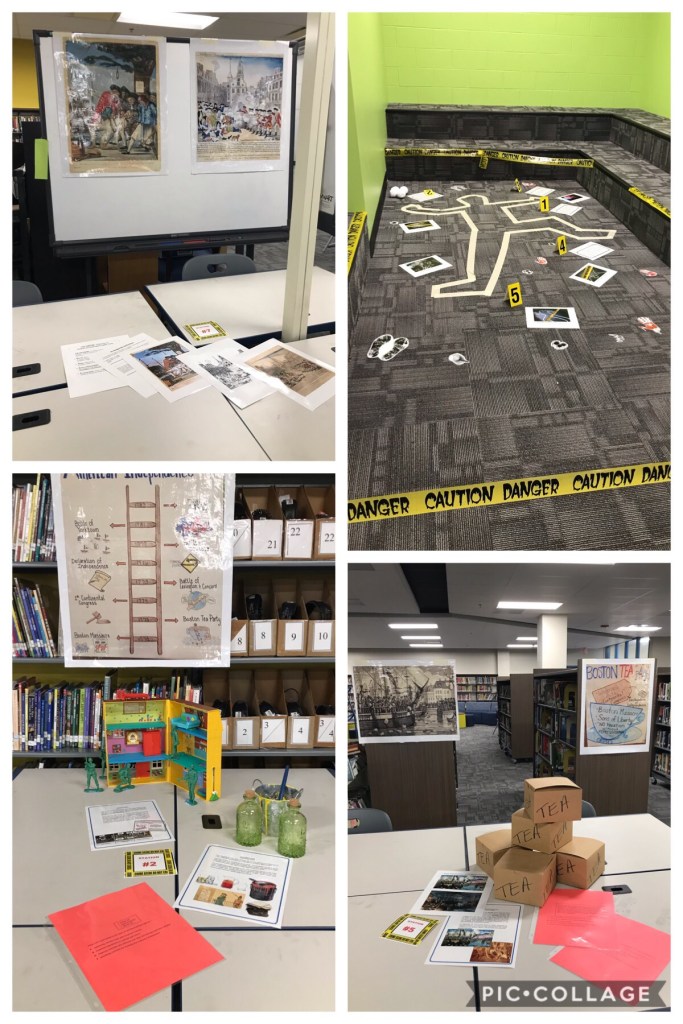
Activities can be the beginning of a great lesson…
You should always start with your state standards. Then move to the activities you want to use to accomplish those standards. Activities can be as long or as short as you want. It all depends on what you are trying to accomplish.
Activities
An activity can be something that quickly accesses a students understanding or it could be an introduction to a new content. The activities I will share here can easily be adapted to the time you have available in your classroom with your students.
Venn Diagram or T Chart
There are times where both a Venn Diagram or a T Chart would work. Giving our students the option to choose helps them take ownership of their learning.
Timeline and More
Our students generally can create a timeline or use a timeline to answer questions. Here students start with a timeline, attach an important quote or excerpt, highlight and or summarize the excerpt and include vocabulary words and definitions that could confuse their peers.
Sorting or Chronological Order
In creating this slide within Google Slides I realized that this could have multiple uses hence the title. You can create these for students to complete or have students create them for their peers to complete.
Sorting or Chronological Order
Silent Structured Conversation
Students can be given a piece of paper that they share with one or two other students where they can have a conversation by writing questions and responses back and forth. Or you could structure the conversation by creating a slide where the speech bubbles have questions and the students go back and forth silently answering them.
Silent Structured Conversation
Chunk Reading
One of the things our students don’t do enough is reading. Using Google Slides they are chunked the reading with some sort of accountability piece attached. This could also be done as a jig saw so that different students read different parts and then share out.
Infographics
Infographics can be so adaptable for students. Students get to have many options which can help with the engagement. We also have many students that are visual learners and this helps them as well.
Cause and Effect Chart Options
Having students think through a cause and effect chart helps them put things in chronological order
Cause and Effect Chart Options
Matching Digital Chart
Using Google Slide Deck you can create a chart where students have to complete the chart by either typing in the information or the teacher providing the fillers for the chart that the student has to move into the correct place.
Linked Slide Activities
You can create a Google Slide Deck where you link the slides together
Dominoes
Use Google Slides to create a variety of ways students can show their knowledge.
How to Create a Hyperdoc
You can create a Hyperdoc that is the collection of information you want the students to learn on a topic. You can include a graphic organizer, videos, excerpts.
Tap and Talk
This activity has students working with either partners or small groups. Students will use a Google Slide that has a collage of pictures on it. The pictures should relate to the vocabulary words that are part of the activity. Students will take turns describing their vocabulary word and choosing one picture that represents it. They will use this in their explanation to their partner. Then the roles are reversed. Students will go back and forth until all of the vocabulary words are covered.
5 Important Words
Students will be assigned an excerpt that they will highlight, circle or draw a box around the most important words. Then using those words they will write a summary. This can be done in Google slides or docs or you could print the activity on paper.
Civil War the Game of Life
Students will work either independently or in a small group working their way through the Google Slide Deck. Here they will take on the role of a Civil War Soldier. They will access videos and record their findings in the designated areas. We are working on their writing skills with the content.
Visual Analysis
While we have students face-to-face and virtual it is important to me to show you activities that can be used in both realms. The one I am sharing today is Picture Analysis. If we only had face-to-face students this is fairly simple. You as the teacher show the students a picture on a screen. You might show the students part of the picture at a time so that students focus on that quadrant. With the mix of teaching possibilities I have moved Picture Analysis to a digital format. Students are told they are to log into the Google Slide Deck with the link I give them. Then they are each assigned a specific slide to work on. This could be an individual or a small group activity. As students work on their assigned slide you as the teacher can see what is happening on their slide. This gives you the opportunity to send individual comments to a group or you might realize that many of your students are confused and you can stop the activity and address the issues.
Importance of Vocabulary
When I was teaching in the classroom my students were assigned their vocabulary as homework where students have the vocabulary word and wrote a kid friendly definition, a sentence with the word. This has to be a sentence that makes sense to me as the teacher so that I know that the student knows the word. I taught middle school students so I would have to stipulate a minimum number of words because I have received sentence that say “I have Constitution”. They then draw a picture with color for our visual students. Our brains will remember longer the more we repeat a word and the more color we use in pictures. The pictures did not have to be an exact drawing but what the student thought of when they thought of that word. That can sound odd but if I ask you to take a few seconds and think of an apple. The picture of an apple you envision may look different compared to the person you are sitting next to. I might like green apples so my picture is a green apple where as you like red apples and your drawing would be of a red apple. This exercise is tailored to that it helps students by engaging them with what is relevant to them. My students were supposed to complete the vocabulary if they had free time at the end of class when they had finished their work or finish it for homework. I understand that this is a lot of work but studies have shown that the more repetition the more it will stimulate the brain for long-term memory. My goal is to have students use methods that increase their long-term memory of vocabulary, which in turn will enhance their life learning. They had about a week or two depending on the topic we were covering to complete their vocabulary.
 Michelle's History Graphics